The blessed month of Ramadan is divided into three distinct stages, each lasting ten days and carrying its own spiritual significance. The first ashra (first ten days) is known as the “Ashra of Mercy” or “Rehmah”. This is the time when Allah’s infinite mercy and blessings descend upon believers like gentle rain. It is an opportunity to begin Ramadan on a note of hope, repentance, and seeking Allah’s favor. During these ten days, Muslims worldwide focus on asking for Allah’s mercy, forgiveness, and guidance as they embark on their Ramadan journey.
The Dua for First Ashra
The beloved Prophet Muhammad صلى الله عليه وسلم taught us specific supplications for each stage of Ramadan. For the first ten days, the recommended dua is:
Arabic:
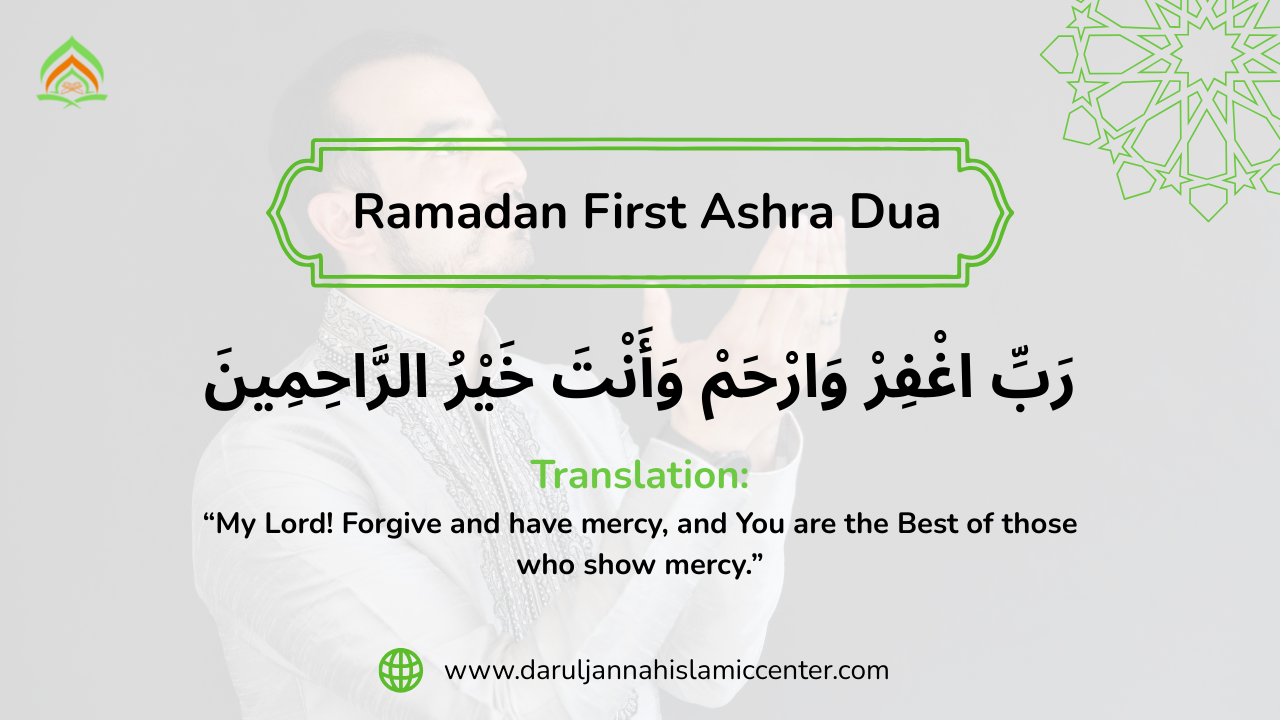
رَبِّ اغْفِرْ وَارْحَمْ وَأَنْتَ خَيْرُ الرَّاحِمِينَ
Transliteration:
Rabbighfir warham wa anta khairur raahimeen
English Translation:
“My Lord! Forgive and have mercy, and You are the Best of those who show mercy.”
(Surah Al-Mu’minun, Verse 118)
This beautiful dua encapsulates the essence of the first ashra—seeking both forgiveness and mercy from Allah سُبْحَانَهُ وَتَعَالَى, acknowledging that His mercy surpasses all else.
Understanding the Dua
| Word | Meaning |
|---|---|
| Rabb | My Lord, My Sustainer |
| Ighfir | Forgive (my sins, my shortcomings) |
| Irham | Have mercy (upon me) |
| Anta | You are |
| Khairur raahimeen | The Best of those who show mercy |
This dua is unique because it combines two essential requests—forgiveness and mercy—while affirming Allah’s supreme position as the Most Merciful. When we recite it, we acknowledge that no one can forgive our sins except Allah سُبْحَانَهُ وَتَعَالَى, and no one’s mercy can compare to His.
Hadith About the First Ashra
Hadith 1: The Three Stages of Ramadan
The Messenger of Allah صلى الله عليه وسلم said:
“It (Ramadan) is the month whose beginning is mercy, its middle is forgiveness, and its end is emancipation from the fire.”
(Sahih Ibn Khuzaymah, Hadith 1887)
This famous hadith establishes the foundation for the three ashras of Ramadan. The first ten days are specifically designated as days of mercy, making it the perfect time to recite the first ashra dua profusely.
Hadith 2: Seeking Mercy in Ramadan
The Prophet صلى الله عليه وسلم said:
“When Ramadan begins, the gates of mercy are opened.”
This hadith emphasizes that from the very first day of Ramadan, Allah’s mercy is abundant and accessible. The first ashra is when these gates are opened widest, inviting believers to enter through sincere supplication and good deeds.
Hadith 3: The One Who is Deprived
The beloved Prophet صلى الله عليه وسلم ascended the pulpit and said:
“Ameen, Ameen, Ameen.”
The companions asked, “O Messenger of Allah صلى الله عليه وسلم, why did you say Ameen?”
He replied:
“Jibril came to me and said: ‘O Muhammad, whoever reaches Ramadan and is not forgiven, then he enters the Fire and Allah removes him far away. Say Ameen.’ So I said Ameen.”
(Sahih Ibn Hibban, Hadith 907)
This powerful hadith reminds us of the immense opportunity Ramadan presents. The first ashra is our chance to begin seeking forgiveness and mercy early, ensuring we do not leave Ramadan empty-handed.
Best Times to Recite the First Ashra Dua
1. During Suhoor (Pre-Dawn Meal)
Allah سُبْحَانَهُ وَتَعَالَى descends to the lowest heaven during the last third of the night, asking, “Who is asking Me, so that I may give him?” This is the most precious time for dua.
2. At the Time of Iftar
The Prophet صلى الله عليه وسلم said: “Indeed, for the fasting person, at the time of breaking the fast, a supplication that is not rejected.” (Sunan Ibn Majah, Hadith 1753)
3. During Prostration (Sajdah)
The Messenger of Allah صلى الله عليه وسلم said: “The closest a servant is to his Lord is when he is in prostration, so increase in supplication.” (Sahih Muslim, Hadith 482)
4. On Fridays (Jumu’ah) During Ramadan
Friday holds special significance, and there is an hour during it when supplications are accepted.
5. Throughout the Day and Night
The first ashra dua can and should be recited at any time—while walking, working, or resting. Consistency is key.
Practical Spiritual Practices for First Ashra
1. Recite the Dua 100 Times Daily
Make it a goal to recite “Rabbighfir warham wa anta khairur raahimeen” at least 100 times each day of the first ten days. Use a counter or prayer beads to track.
2. Perform Extra Nawafil (Voluntary Prayers)
Offer 2 rakats of Salatul Tasbih or Salatul Hajj, specifically asking Allah سُبْحَانَهُ وَتَعَالَى for His mercy.
3. Give Charity (Sadaqah)
The Prophet صلى الله عليه وسلم was the most generous during Ramadan. Give daily charity, even if small, with the intention of attracting Allah’s mercy.
4. Read Quran with Translation
Focus on verses that discuss Allah’s mercy, such as Surah Al-Fatihah, Surah Ar-Rahman, and Ayat-ul-Kursi.
5. Make a Mercy List
Each day, write down one blessing you are grateful for and ask Allah سُبْحَانَهُ وَتَعَالَى to increase His mercy upon you in that area.
6. Seek Forgiveness for Others
The Prophet صلى الله عليه وسلم said: “Seeking forgiveness for the believing men and believing women brings mercy.” Make dua for your parents, family, friends, and the entire Ummah.
Daily Mercy Checklist for First Ashra
First Ashra Ramadan Checklist
Ashra of Mercy | رحمت
“Its beginning is mercy” — Prophet Muhammad ﷺ
📿 First Ashra Dua:
رَبِّ اغْفِرْ وَارْحَمْ وَأَنْتَ خَيْرُ الرَّاحِمِينَ
Rabbighfir warham wa anta khairur raahimeen
“My Lord! Forgive and have mercy, and You are the Best of those who show mercy.”
✨ Start your first ashra journey today!
| Day | Daily Tasks | Completed |
|---|
✓ Your progress is saved in your browser. Clear browser history to reset.
May Allah سُبْحَانَهُ وَتَعَالَى accept our efforts. Ameen.
Print this checklist and track your spiritual progress throughout the first ashra.
The Connection Between Mercy and Forgiveness
In the first ashra dua, we ask for both forgiveness and mercy together. Why?
Allah سُبْحَانَهُ وَتَعَالَى says in the Quran:
“And My mercy encompasses all things.”
(Surah Al-A’raf, Verse 156)
Forgiveness removes the barrier of sin between us and Allah. Mercy then fills that space with blessings, love, and spiritual elevation. Without forgiveness, we remain burdened. Without mercy, we remain empty. The first ashra dua seeks both, preparing us for the remaining stages of Ramadan.
Inspiring Story of Mercy
A man came to the Prophet صلى الله عليه وسلم and said, “O Messenger of Allah, I have committed many sins. Will Allah forgive me?”
The Prophet صلى الله عليه وسلم replied: “Do you not know that Islam erases what came before it, and hijrah (migration) erases what came before it, and Hajj erases what came before it?”
The man asked, “But what about during Ramadan?”
The Prophet صلى الله عليه وسلم smiled and said: “And Ramadan—whoever fasts it with faith and seeking reward, his previous sins will be forgiven.”
This story reminds us that the first ashra is the beginning of a month designed for our complete spiritual renewal.
Beautiful Quranic Verses About Mercy for First Ashra
Verse 1:
“Say, ‘O My servants who have transgressed against themselves, do not despair of the mercy of Allah. Indeed, Allah forgives all sins. Indeed, it is He who is the Forgiving, the Merciful.'”
(Surah Az-Zumar, Verse 53)
Verse 2:
“And your Lord says, ‘Call upon Me; I will respond to you.'”
(Surah Ghafir, Verse 60)
Verse 3:
“And when My servants ask you concerning Me, indeed I am near. I respond to the invocation of the supplicant when he calls upon Me.”
(Surah Al-Baqarah, Verse 186)
Recite these verses during the first ashra to strengthen your connection with Allah’s mercy.
Common Mistakes to Avoid in First Ashra
❌ Focusing Only on Food
Many people spend the first ten days preoccupied with iftar menus and grocery shopping. Remember—the real nourishment is spiritual.
❌ Neglecting Tahajjud
The pre-dawn hours are when mercy descends most abundantly. Do not sleep through them.
❌ Forgetting Family
The Prophet صلى الله عليه وسلم taught us to begin with those we are responsible for. Make dua for your family’s mercy and forgiveness.
❌ Quantity Over Quality
It’s better to recite the first ashra dua with presence of heart ten times than to rush through it a thousand times.
❌ Ignoring Sincere Repentance
Mercy is for those who turn back to Allah سُبْحَانَهُ وَتَعَالَى sincerely. Combine your dua with genuine intention to change.
Summary
The first ashra of Ramadan is a divine gift—ten days dedicated entirely to mercy from Allah سُبْحَانَهُ وَتَعَالَى. The dua “Rabbighfir warham wa anta khairur raahimeen” serves as our key to unlock this mercy, combining our need for forgiveness with our hope for His compassion.
As the Prophet صلى الله عليه وسلم taught us, Ramadan begins with mercy, and those who fail to attain it are truly deprived. By reciting this dua consistently, at the best times, with sincere hearts, we position ourselves to receive Allah’s boundless mercy. This mercy then carries us through the remaining ashras—forgiveness and salvation from hellfire.
Remember, the first ten days set the tone for the entire month. Start strong, seek mercy earnestly, and watch how Allah سُبْحَانَهُ وَتَعَالَى transforms your Ramadan experience.
Practice Idea: 10-Day Mercy Challenge
Challenge Yourself:
Day 1: Recite first ashra dua 100 times. Give £1 charity.
Day 2: Recite dua 100 times. Make dua for 10 people by name.
Day 3: Recite dua 100 times. Read Surah Ar-Rahman with translation.
Day 4: Recite dua 100 times. Forgive someone who wronged you.
Day 5: Recite dua 100 times. Visit a sick person or call someone lonely.
Day 6: Recite dua 100 times. Feed a fasting person.
Day 7: Recite dua 100 times. Pray Tahajjud for 10 minutes.
Day 8: Recite dua 100 times. Make a list of 50 blessings.
Day 9: Recite dua 100 times. Seek forgiveness for the entire Ummah.
Day 10: Recite dua 1000 times. Make a major charity donation.
At the end of ten days, reflect on how your heart has softened and how Allah’s mercy has manifested in your life.
Prayer for Acceptance
O Allah سُبْحَانَهُ وَتَعَالَى, Lord of the worlds, the Most Gracious, the Most Merciful. We come before You in this blessed first ashra of Ramadan, our hearts filled with hope in Your infinite mercy.
رَبَّنَا ظَلَمْنَا أَنفُسَنَا وَإِن لَّمْ تَغْفِرْ لَنَا وَتَرْحَمْنَا لَنَكُونَنَّ مِنَ الْخَاسِرِينَ
“Our Lord, we have wronged ourselves, and if You do not forgive us and have mercy upon us, we will surely be among the losers.”
(Surah Al-A’raf, Verse 23)
O Most Merciful, shower Your mercy upon us in these first ten days. Forgive our sins, cover our faults, and accept our humble supplications. Let us taste the sweetness of Your mercy and feel its warmth in our hearts.
رَبَّنَا آتِنَا فِي الدُّنْيَا حَسَنَةً وَفِي الْآخِرَةِ حَسَنَةً وَقِنَا عَذَابَ النَّارِ
“Our Lord, give us in this world good, and in the Hereafter good, and protect us from the punishment of the Fire.”
(Surah Al-Baqarah, Verse 201)
O Allah سُبْحَانَهُ وَتَعَالَى, we ask You by Your mercy that encompasses all things to envelop us in Your mercy, to forgive us, and to admit us into Your Paradise by Your mercy alone.
Ameen, Yaa Rabbil Aalameen.
Sources and References
| Topic | Source |
|---|---|
| First Ashra Dua | Surah Al-Mu’minun, Verse 118 |
| Hadith on Three Stages of Ramadan | Sahih Ibn Khuzaymah, Hadith 1887 |
| Hadith on Gates of Mercy Opened | Sahih Muslim, Hadith 1079 |
| Hadith on Jibril Saying Ameen | Sahih Ibn Hibban, Hadith 907 |
| Hadith on Dua at Iftar | Sunan Ibn Majah, Hadith 1753 |
| Hadith on Prostration | Sahih Muslim, Hadith 482 |
| Verse on Allah’s Nearness | Surah Al-Baqarah, Verse 186 |
| Verse on Despair Not of Mercy | Surah Az-Zumar, Verse 53 |
| Verse on Allah Responding | Surah Ghafir, Verse 60 |
| Verse on Allah’s Mercy Encompassing | Surah Al-A’raf, Verse 156 |
May Allah سُبْحَانَهُ وَتَعَالَى accept our fasts, our prayers, and our duas during this blessed first ashra of Ramadan. May His mercy envelop us, His forgiveness cleanse us, and His love fill our hearts. Ameen.